Family gatherings with a preschooler: how to help your child feel at ease among relatives
A long weekend, a trip to the grandparents and a table full of relatives. For adults it’s a chance to catch up. For a preschooler it can be a lot all at once: new faces, loud conversations, an aunt who wants a kiss, and a day that’s nothing like an ordinary one.
It helps to know how to support your child at family gatherings, so that time with your loved ones is enjoyable for them and for you.
📌 In this article you’ll learn:
Why family gatherings can be hard for a child
To an adult, an uncle from the other side of the country is family. To a three-year-old who last saw him a year ago, he’s a complete stranger. Add to that lots of people in one room, several conversations going on at once, unfamiliar food and no set times for naps or meals.
A preschooler is still learning to cope with that much going on. If at first your child hides behind you or doesn’t want to talk, it’s usually a sign that they need a moment to look around and feel safe.
Hugs and kisses hello: how to respect both your child and grandma
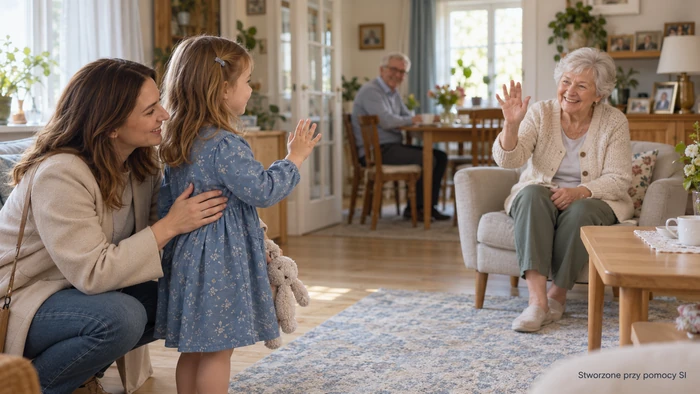
“Give grandma a kiss” is something you hear in many homes. Grandma means well, but sometimes a child simply isn’t ready. It helps to give them a choice: they can wave, give a high five, shake hands or just say “hi”. Your child learns that their body belongs to them, and the greeting is still warm.
A quick word with the grandparents before the visit, or on the side, also helps: “Give him a moment, he’ll come over to you in fifteen minutes.” That’s usually exactly what happens.
An everyday example: Four-year-old Zosia arrives at her grandparents’ after a few months apart. At the door she hides behind her mum. Instead of coaxing her into a hug, her mum says: “Zosia will say hello once she’s settled in.” Grandma nods and goes back to the kitchen. Fifteen minutes later Zosia comes over by herself to show grandma her new doll and climbs onto her lap.
How to prepare your child before the trip
Children feel more confident when they know what to expect. A day or two before, tell your child where you’re going and who you’ll see there. Looking at photos of relatives works well: “This is Auntie Ania, she has a dog you’ll get to meet.”
Pack something of their “own” together, like a favourite cuddly toy or a book. In a new place, an object like this gives a child a sense of security. We write about how important a predictable daily rhythm is for children in our article on daily routine at home and at preschool.
What helps while you’re there
It’s good to have a quiet corner ready where your child can retreat when it gets too loud. It could be the room next door or a short walk around the garden with a parent. A few minutes’ break is often enough for a child to come back to the table in a better mood.
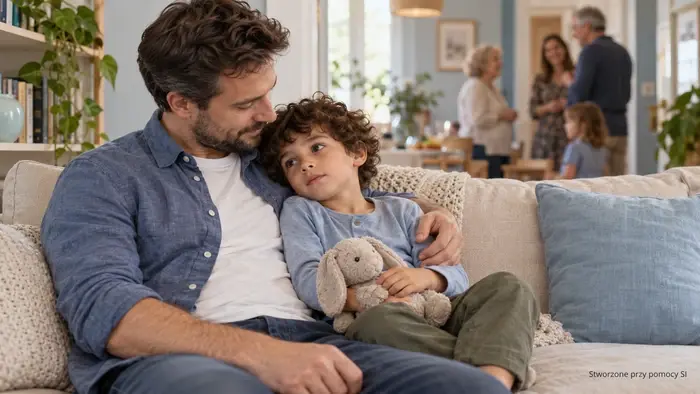
It also helps to lower your expectations. A preschooler won’t sit nicely at the table for three hours and doesn’t have to eat everything on their plate. If you can, keep at least part of the usual rhythm, such as nap time or the bedtime story.
When difficult emotions come up, naming them and staying close helps. We write more about this in our article How to support your child’s emotions in difficult moments.
What to expect after you get back
Sometimes a child is cheerful all day at the grandparents’ and then, on the way home or the next morning, suddenly cries over the smallest thing. That’s usually tiredness and too many impressions, which only come out once the child is back in a safe, familiar place.
After a weekend like that, a calmer day and a bit more closeness will help. It’s also good to talk about the visit: “What did you like best at grandma’s?” A conversation like this helps a child make sense of what they experienced.
How we practise this at Niebieska Przystań
At preschool, children say hello and goodbye to others every day, and along the way they learn to say what they need. During the morning greeting circle, each child chooses how they want to say hello, for example with a high five or a smile.
We also practise saying “no” in a calm, polite way and asking for a break when it gets too loud. These are the same skills that come in handy later at the family table.
What can you do today?
- Tell your child who you’ll see at the weekend and look at photos of your relatives together
- Pack a favourite cuddly toy or book together
- Let the grandparents know your child may need a moment to say hello
- Agree with your child on where they can rest when it gets too loud
- Plan a calm day for after you get back
Frequently asked questions
Does my child have to hug relatives when saying hello?
No. Your child can say hello in their own way, for example by waving or saying “hi”. It’s worth letting the grandparents know in advance that your little one needs a moment to warm up.
How can I prepare my preschooler to meet family they haven’t seen for a long time?
A short chat before the trip and looking at photos of relatives both help. A child who knows who they’ll meet and what will happen feels more confident.
What should I do if my child hides behind me and won’t talk?
Give them time. Most children start to open up on their own after watching for a quarter of an hour or so. Pushing them usually makes that moment last longer.
Why is my child grumpy after a family gathering?
Lots of new people and a change in the daily rhythm tire a young child more than an adult. Emotions often only come out in the evening or the next day, once the child is back somewhere safe.
How should I respond when relatives comment on my child’s behaviour?
Calmly and briefly, for example: “He needs a moment, he’ll come over in a bit.” Your child then hears that you’re on their side.
Want to know more?
If you’d like to see how we support children in getting along with others every day, we’ll be happy to tell you about it at a meeting. Enrolment for the 2026/2027 school year is open.
💙 From Niebieska Przystań 💙
We start every morning with a greeting the child chooses for themselves. Sometimes it’s a high five, and sometimes just a quiet “hi”.