Psychologist at preschool: when and why?

Many parents link a psychologist with serious problems. Yet at preschool, a psychologist is above all someone who supports children, their parents and the teachers every day.
It helps to know what a preschool psychologist does and when you can come to them with a question. Often a single conversation is enough for a parent to feel more confident.
A psychologist at preschool means everyday support, right on site. They help children cope better with their emotions and help parents understand what is going on with their child.
📌 In this article you’ll find out:
What a preschool psychologist does
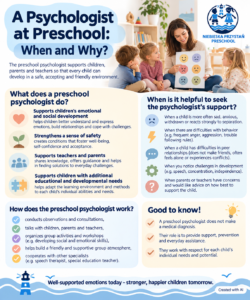
A psychologist watches children during play and activities, and runs sessions about emotions and working together in a group. They also support teachers who are looking for a way to handle a trickier situation in the group.
For parents, the psychologist is someone you can talk to about your child’s behaviour, emotions or friendships. Such a conversation doesn’t have to be about any problem at all.
When it’s worth talking to a psychologist
It’s good to turn to the psychologist when something makes you wonder. For example, your child takes goodbyes hard for a long time, gets angry often, pulls back from playing with others or is going through a big change in the family.
Sometimes a parent simply wants to ask whether a certain behaviour is typical for their child’s age. The psychologist will help you look at the situation calmly and suggest how to support your child at home.
An everyday example: Kuba’s dad noticed that after his sister was born, his son got angry more often and asked for help with things he used to do on his own. He talked to the preschool psychologist. He learned that this is a common reaction to a new sibling and got a few simple ideas for time just for the two of them. After a few weeks, Kuba was getting dressed by himself in the morning again.
How a psychologist supports children in the group
With the psychologist, children learn to name their emotions and solve conflicts. This happens through play and stories, in small groups. For the children, it’s just another activity, with no stress.
These sessions are part of a wider emotional education, which we write about in the article Why is emotional education so important at preschool?.
How a psychologist works with other specialists
A preschool usually has a whole team: teachers, a speech therapist, a sensory integration therapist and a psychologist. They share what they notice, so the support a child gets is consistent.
For example, difficulties with speaking can affect how a child feels in the group. Then the psychologist and the speech therapist work together. You can read more about a speech therapist’s work in the post When is it worth seeing a speech therapist?.
What it looks like at Niebieska Przystań
At our preschool, the psychologist, speech therapist and sensory integration therapist work on site. Children know them from everyday activities, so meeting them feels natural. Parents can arrange a conversation whenever they have a question.
Thanks to small groups of no more than 14 children, our specialists and teachers know every child well and quickly notice when someone needs extra support.
What can you do today?
- Write down which of your child’s behaviours makes you wonder, and since when
- Ask at preschool how to arrange a conversation with the psychologist
- Talk to your child’s teacher about what she has noticed
- Remember that asking a psychologist is simply good practice
Frequently asked questions
Does talking to a psychologist mean something is wrong with my child?
No. A preschool psychologist supports all children and parents. Many parents come simply to ask whether a certain behaviour is typical for their child’s age.
Does my child know they are meeting a psychologist?
For a child, it’s just an activity or playtime with someone they know from preschool. There is no stress involved.
How do I arrange a conversation with the psychologist?
The easiest way is to ask your child’s teacher or the preschool management. The psychologist will arrange a time that suits you.
Can the psychologist also help with things at home?
Yes, if they concern your child. They can suggest how to support your child when a sibling is born or when you move house.
Does the psychologist work with the teachers?
Yes. The psychologist, teachers and other specialists share what they notice, so the support your child gets is consistent across the whole preschool.
Want to know more?
If you’d like to meet our specialists and find out how they support children every day, we’ll be happy to tell you about it at a meeting.
💙 From Niebieska Przystań 💙
Here, specialists are part of everyday life, not a special occasion.