Why is it worth talking to your child about emotions?
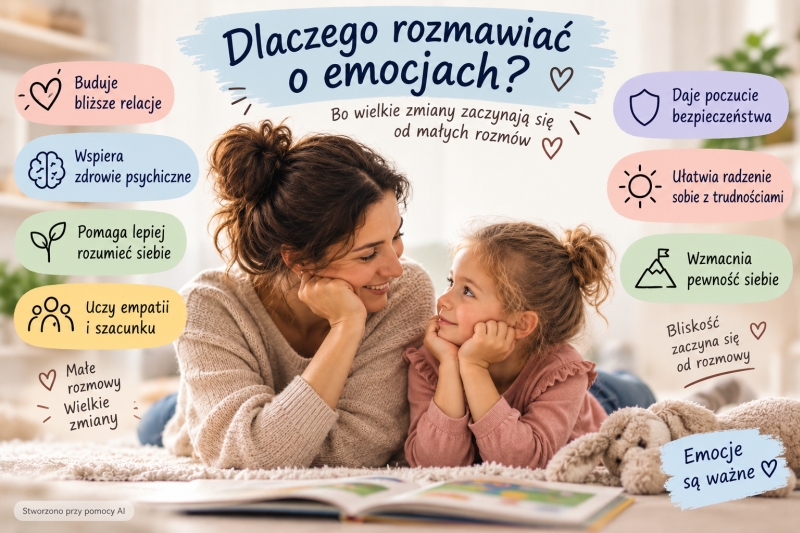
A child who doesn’t yet have words for anger or sadness often shows them through behaviour — shouting, crying, slamming doors. Talking about emotions doesn’t make them disappear, but it changes how a child copes with them.
Talking about emotions doesn’t mean that anger, sadness or frustration will go away. But it does help a child build the vocabulary they need to talk about what they’re going through, and to understand it better over time.
📌 In this article you’ll learn:
- What happens when a child doesn’t yet have words for what they feel,
- Why it’s worth helping a child name an emotion,
- How talking about emotions can build trust between child and parent,
- Why children learn to talk about emotions by watching adults,
- How we talk about emotions at Niebieska Przystań,
- Why these skills matter in the years to come,
- What you can do at home today.
What happens when a child doesn’t yet have words for what they feel?
A young child can feel anger, sadness, disappointment or frustration very intensely, and yet not be able to say:
“I’m angry because I wanted to stay longer at the playground”.
So we often see emotions mainly in behaviour. The child cries, shouts, refuses to cooperate, throws a toy, withdraws or simply says: “No!”.
It’s easy for a parent to think: “They’re misbehaving again”.
But it’s worth trying to look one step further and ask yourself:
“What is my child trying to tell me with their behaviour right now?”
That doesn’t mean every behaviour has to be accepted. We can stop a child who is hitting, throwing things or hurting someone, and at the same time help them name what they feel.
You could say:
“I can see you’re really angry. I won’t let you hit. You can be angry, but you can’t hit me.”
This way the child gets two important messages at once:
the emotion is OK, but not every behaviour that comes with it is allowed.
Why is it worth helping a child name an emotion?
Naming emotions helps a child gradually recognise what’s happening inside them and build the vocabulary they need to talk about it.
When a child is crying, we can say:
“I can see you’re sad because you really wanted to stay at the playground a bit longer.”
When they’re angry after losing a game:
“I think you’re angry because you really wanted to win.”
We don’t always have to know exactly what a child is feeling. If we’re not sure, we can say:
“I can see something upset you. Do you want to tell me what happened?”
Naming an emotion won’t make the problem go away. But it can help a child feel noticed and understood, and gradually learn to link certain feelings with the right words.
That’s a big difference compared with saying:
“There’s nothing to worry about.”
“Nothing even happened.”
“Don’t cry.”
To an adult the situation may seem small. To a child, in that moment, it can really matter.
If emotions are already very strong and it’s hard for your child to calm down, talking alone may not be enough.
We write more about what you can do in those situations in our article
How to support your child’s emotions in difficult moments.
How does talking about emotions build trust between you?
When a child finds that they can tell a parent about anger, sadness, jealousy or fear without being laughed at or judged straight away, they learn that they can come to an adult with difficult things.
You don’t have to solve the problem right away.
Sometimes a child’s first need is simply to be heard.
An everyday example:
a child comes home from preschool and says that nobody wanted to play with them on the playground.
A parent’s first instinct might be:
“Don’t worry, I’m sure tomorrow will be better.”
But you can first stay with what your child is going through:
“That must have felt sad. You wanted to play with them, and they said no.”
Only then might you ask:
“Do you want to tell me what happened next?”
The child then gets the message:
“I can talk about something difficult and someone wants to listen.”
Why does a child learn to talk about emotions by watching you?
Children don’t only learn when we explain things to them. They learn a great deal about emotions by watching adults.
If a parent can say:
“I’m tired today, so it’s a bit harder for me to be patient.”
or:
“I got upset. I need a moment to calm down.”
the child sees that emotions can be noticed, named and put into words.
This doesn’t mean a parent should tell their child about all their problems.
It’s more about simple, age-appropriate messages that show:
“Adults have emotions too, and they can talk about them.”
How do we talk about emotions at Niebieska Przystań?
Talking about emotions doesn’t have to happen only in special sessions.
Many of the most important moments come up spontaneously during an ordinary preschool day.
Someone took a toy.
Two children both want to be first.
A friend doesn’t want to play the same game.
A favourite activity has to end.
The tower wouldn’t stay up.
A child misses their parent in the morning.
These are exactly the moments that give children a chance to learn to recognise and name emotions.
A teacher can help the child pause and say:
“I can see you got angry because you wanted to play with that car.”
or:
“I think you felt sad when you heard you can’t join the game right now.”
Then you can think together about what to do next:
ask for the toy, wait for your turn, tell a friend what you want, or ask an adult for help.
At Niebieska Przystań, what matters to us is not only how we respond to a difficult situation, but also trying to understand what lies behind a child’s behaviour.
Teachers observe children during everyday activities, and if certain difficulties keep coming back or need a wider view, they can draw on the support of the specialists who work at the preschool.
We write more about our approach in our article
Why is emotional education so important at preschool.
Why does talking about emotions matter in the long run too?
Being able to recognise and name their own emotions isn’t something a child needs only at preschool age.
In the years that follow, new situations come up:
conflicts with peers, first failures, school demands, changes, stress and more complicated relationships.
We can’t stop a child from feeling anger, sadness, disappointment or fear.
But we can gradually help them build the language that lets them say, instead of only acting it out:
“I’m angry.”
“That made me sad.”
“I’m scared.”
“I didn’t like that.”
“I need help.”
These are skills that develop gradually and need many everyday experiences.
What can you do today?
You don’t need special worksheets or long talks about emotions.
The most opportunities come up during an ordinary day.
-
Name what you see.
Instead of “calm down”, try: “I can see you’re really angry”. -
Don’t guess at all costs.
If you don’t know what your child is feeling, you can say:
“I can see something happened. Do you want to tell me about it?”. -
Don’t deny the emotion.
Instead of “there’s nothing to worry about”, try:
“I can see that mattered to you”. -
Separate the emotion from the behaviour.
“You can be angry, but you can’t hit” gives your child a clear limit without denying what they feel. -
Sometimes talk about your own emotions.
A simple “I’m tired and I need a moment’s rest” shows your child how to talk about how they’re feeling. -
In the evening, ask about one good moment and one difficult moment.
It’s often easier for a child than the general question: “How was preschool?”.
Frequently asked questions about talking to your child about emotions
Why does talking about emotions matter even with young children?
Young children gradually learn to link simple words such as “sad”, “angry” or “happy” with what is happening to them and to others. When adults name emotions every day, it helps children build the vocabulary they need to talk about their experiences.
What happens when a child can’t yet say what they feel?
Emotions may then show mainly in behaviour – crying, shouting, withdrawing, refusing or reacting strongly. This doesn’t automatically mean something worrying is going on. The child may simply need an adult’s help to recognise and name what they’re going through.
Will naming anger or sadness make my child focus more on difficult emotions?
Naming emotions doesn’t mean encouraging a child to dwell on them. Rather, it helps them gradually recognise their own experiences and build the words to talk about them. Naming an emotion won’t solve every problem, though, and won’t always calm a child straight away.
What should I say to a child who is very angry?
It helps to use short messages. You can say: “I can see you’re really angry” or “I’m here. We’ll talk when you’re ready”. If the child is hitting or throwing things, the adult should also set a clear limit, for example: “You can be angry, but I won’t let you hit”.
Why does the way a parent talks about their own emotions matter?
Children also learn by watching adults. When a parent simply says: “I got upset, I need a moment”, they show the child that emotions can be noticed, named and put into words.
Does preschool affect how a child learns to cope with emotions?
Preschool gives many natural chances to learn to recognise emotions, express needs, wait for a turn and resolve conflicts. At Niebieska Przystań we use everyday situations to help children name what they feel and find ways to cope with difficult moments.
Would you like to get to know Niebieska Przystań?
If you’d like to see how we support children’s emotional development during an ordinary preschool day, come to Niebieska Przystań in Wilanów, Warsaw. At a meeting you can learn about our approach, see the preschool and talk with us about your child’s needs.
💙 From Niebieska Przystań 💙
It’s not about a child never feeling anger, sadness or frustration. We want to help them gradually understand what’s happening inside them, name their emotions and know that in a difficult moment they can turn to an adult.