Gifts for preschoolers: what really helps them grow and brings lasting joy?
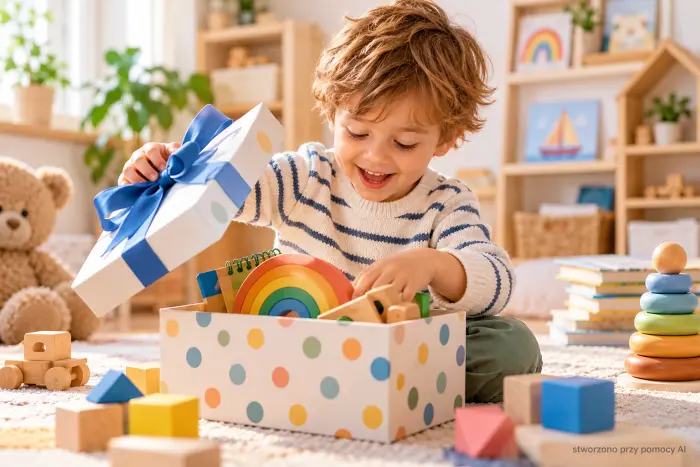
Under the Christmas tree there is a mountain of boxes, yet a week later the child is happily playing with a pot and a cardboard box. Many parents know this scene from their own home.
A good gift for a preschooler doesn’t have to be expensive or make noise. The things that bring joy the longest are the ones a child can play with in many different ways.
The best toys are the ones where the child does most of the work, not the toy. That is how imagination and the ability to play with others grow. A gift like that brings joy for much longer.
📌 In this article you will learn:
What are open-ended toys and why are they worth choosing?
Open-ended toys are toys that don’t have just one way of being used. Blocks, wooden figures, play silks or construction sets can be a castle today and a ship tomorrow.
Your child makes up the story and the rules of the game. Along the way, they practise imagination and planning. We write more about how play supports development in our article Learning through play – how does it support a child’s development?.
Why give a game for the whole family?
Simple board games and card games are a gift not only for the child, but for the whole family. They teach children to wait for their turn, to count and to cope with losing.
For younger preschoolers, cooperative games are a great choice: everyone plays together against the board. We write about how to help a child cope with losing in our post Competition in the group: when your child wants to be first.
Which gifts support creativity?
Paints, big sheets of paper, modelling clay, crayons and child-safe scissors make a set that never gets boring. Your child can create without a ready-made pattern, and every piece of work is different.
Simple instruments, such as a small drum or a xylophone, are also a lovely idea. Music is great for development, as we explain in our article Why does music matter in a preschooler’s life?.
Why time together is a gift that stays in the memory
For a preschooler, time spent with loved ones is incredibly valuable. A ticket to a puppet theatre, baking gingerbread together or a “voucher for a trip with Grandma” often bring more joy than yet another toy.
Gifts like these build memories and relationships. Children look forward to them eagerly and talk about them for a long time.
An everyday example: Instead of another doll, Maja’s parents gave her an “adventure calendar”: one card for each month with a plan, such as sledging with Dad or a trip to the zoo with her aunt. Every month Maja happily uncovers a new card and tells everyone about it.
How many gifts is too many?
When there are lots of gifts, a child quickly jumps from one to the next and doesn’t play with any of them for long. Less is often more. You can also put some gifts away and bring them out a few weeks later.
It’s a good idea to agree with the family who is buying what. That way gifts don’t repeat, and your child gets things they will really use.
What can you do today?
- Notice which toys your child plays with the longest
- Choose one game you can play as a whole family
- Think about a gift in the form of a trip or outing together
- Agree with your family who is buying which gift
Frequently asked questions
What gift should I choose for a three-year-old?
Large building blocks, simple puzzles, crayons and role-play toys, such as a play kitchen or a doctor’s kit, work well. The most important thing is that they are safe and suited to the child’s age.
Are educational toys with buttons a good gift?
They can be fun for a while, but they usually get boring faster than open-ended toys. Children learn the most when they make up the game themselves.
Should I give a preschooler a tablet as a gift?
It’s better to wait and choose toys that get your child moving and using their imagination. We write about sensible screen rules in a separate post on our blog.
How can I deal with too many gifts from the family?
You can put some gifts away and bring them out gradually. It also helps to tell the family in advance what will really make your child happy.
Can experiences replace a gift?
Yes. A trip to the theatre or an afternoon on the ice rink together often stays in a child’s memory longer than a toy.
Want to know more?
If you’d like to see the toys and materials children play with at our preschool, we’d love to invite you to a meeting.
💙 From Niebieska Przystań 💙
The most beautiful gifts are the ones that let a child spend time with the people they love.