Fear and worries in preschoolers: how to help when your child is scared
In the evening the night light has to stay on, because “something is” under the bed. On a walk your child hides behind you at the sight of a dog, and the vacuum cleaner ends in tears every single time. A preschooler’s fears can be surprising, especially when they appear suddenly in a child who until now wasn’t afraid of anything.
It helps to know where fear in preschoolers comes from and how to respond so that your child feels safe with you.
📌 In this article you’ll learn:
Where fears come from at preschool age
Between the ages of three and six, a child’s imagination develops very quickly. A preschooler can already invent a whole story about a dragon living in the wardrobe, but can’t always tell what is made up from what is real. Hence the monsters under the bed and the shadows that look completely different at night than during the day.
On top of that comes a growing awareness of the world. A child starts to understand that some things can hurt or turn out differently than expected. Fears at this age are an ordinary sign of development, and most of them pass on their own when the child feels supported by adults.
What preschoolers are most often afraid of
The list can be long and changes from month to month. Common fears include:
- the dark and falling asleep without a light on,
- monsters, ghosts and characters from cartoons,
- dogs and other animals, even quite small ones,
- loud noises, like the vacuum cleaner, the hairdryer or a thunderstorm,
- going to the doctor or the dentist,
- costumes and masks, which around Halloween are on display in shops everywhere.
Sometimes a child is afraid of something that seems completely harmless to an adult, such as the toilet flushing or balloons popping. For the child, these fears are just as real as the more “typical” ones.
How to respond when your child is scared
A parent’s first reflex is often to reassure: “Don’t be scared, there’s nothing there.” The intention is good, but what the child mostly hears is that their feeling is wrong. It works better to start by naming what is happening: “I can see you’re scared. I’m right here.”
When a child feels their fear has been noticed, it’s easier for them to calm down and listen to what you have to say. We write more about why naming emotions helps so much in our article Why talk to your child about emotions?
An everyday example: Five-year-old Staś hasn’t wanted to fall asleep alone for a few days, because “someone is in the wardrobe”. Instead of trying to convince him that monsters don’t exist, his mum sits on the bed and asks what this someone looks like. Staś describes a big, hairy creature. Together they decide the creature is afraid of torches, so a torch stays by the bed for the night. The next evening Staś looks into the wardrobe himself and falls asleep much more calmly.
How to ease fear in small steps
Fear can’t be switched off with a single sentence. What you can do is help your child get closer to what scares them, at their own pace. If they’re afraid of dogs, it’s enough to start by watching them from a distance in the park or reading books about dogs together. Stroking a friend’s calm dog can come later, even a few weeks later.
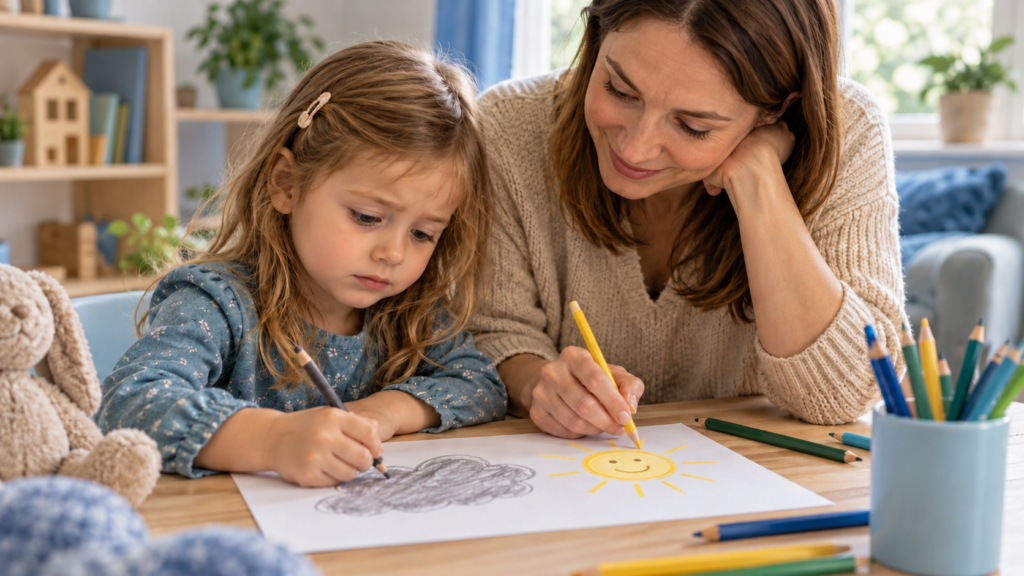
Play works well too. Treating a teddy bear, a shadow puppet show with a torch, drawing a monster that gets a funny hat or building a safe den out of blankets all give a child the sense that they are in control. We write about how much children learn this way in our article on learning through play.
Before situations you can predict, like a trip to the dentist, a calm heads-up helps. Briefly explain what will happen, and don’t promise “you won’t feel a thing” if you’re not sure. A child who knows what to expect usually copes better.
How we talk about fear at Niebieska Przystań
At preschool, fear shows up in lots of small situations, for example during a storm outside the window, or when someone suddenly starts crying while playing in a dark tent. Our teachers then stop by the child, name what they’re feeling and help them find a way to cope.
We also talk about emotions over books and in circle-time games. That way fear becomes something you can say out loud, and children know they can come to an adult with any worry. Our preschool also has a psychologist whom parents can talk to when something concerns them.
When to look for extra support
Most preschool fears fade on their own within a few weeks or months. It’s worth talking to a teacher or a psychologist if fear makes everyday life much harder: your child stops wanting to leave the house, sleeps badly for a long time, becomes afraid of things they used to enjoy, or the fears are multiplying rather than fading. A conversation like this helps you look at the situation calmly and find support that fits your child.
What can you do today?
- Instead of “don’t be scared”, say “I can see you’re scared, I’m right here”
- Ask your child what the scary thing looks like and listen without correcting
- Leave a small night light on if it helps your child
- Play something that eases the fear, like being a doctor for a teddy
- Give advance notice of situations that might be difficult
Frequently asked questions
Is it normal for a preschooler to be afraid of the dark?
Yes, it’s one of the most common fears at this age. A child’s imagination is very active, and in the dark it’s easy to see shapes that aren’t there during the day. A small night light and a calm bedtime routine usually help a lot.
Won’t leaving the light on make the fear last longer?
A night light gives a child a sense of safety and helps them fall asleep. Over time, as the fear fades, children often start giving it up on their own, so there’s no need to rush it.
How can I prepare my child for going to the doctor?
A short, calm conversation a few days before and playing doctor at home both help. Tell the truth about what will happen in simple words, and bring a favourite cuddly toy along.
What should I do if my child is afraid of dogs?
It’s best to ease this fear gradually, starting by watching dogs from a distance. Meeting a calm dog belonging to friends can come later, when the child feels ready. Pushing them to stroke a dog usually makes the fear stronger.
When should a preschooler’s fear be a concern?
When it makes everyday life harder for a long time, for example the child stops wanting to leave the house or sleeps very badly. That’s a good moment to talk to a teacher or the psychologist at preschool.
Want to know more?
If you’d like to see how we talk with children about emotions every day, we’ll be happy to tell you about it at a meeting. Enrolment for the 2026/2027 school year is open.
💙 From Niebieska Przystań 💙
When a preschooler says they’re scared, the first thing we do is sit down next to them. Scary things are easier to talk about when a child knows they’re not alone with them.